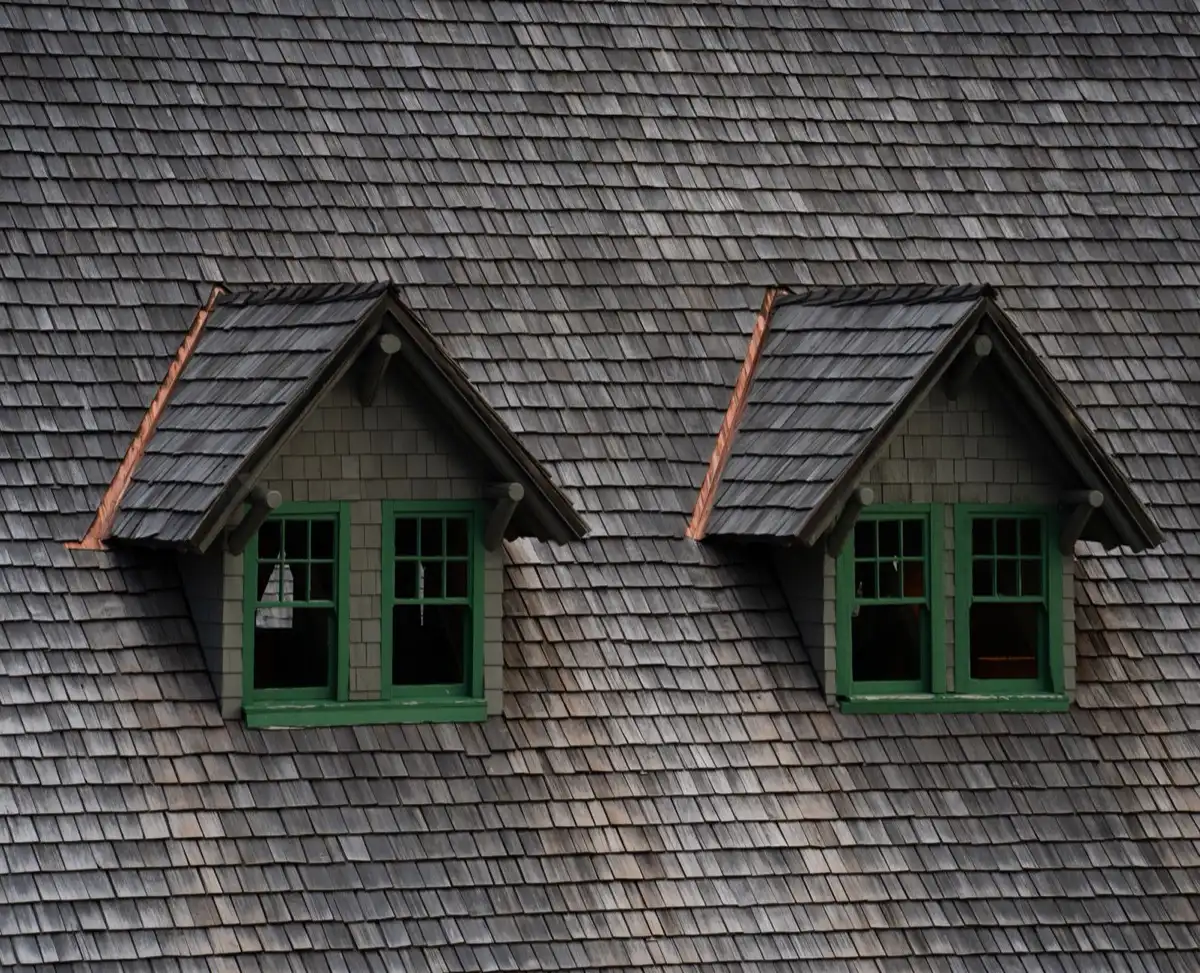
A homeowner cannot see flashing fail. It is behind the shingles, behind the siding and above the ceiling, and by the time it announces itself the announcement is a stain, a soft spot in a wall, or a bill with the word "sheathing" in it.
Which is why most of what gets sold as a roof leak is not a hole in anything. It is a flashing detail that was never right.
Roof flashing types, and what each one does
Flashing is thin metal at the joints. Shingles handle open slope; flashing handles everywhere it stops.
| Detail | Where it lives | How it fails |
|---|---|---|
| Step flashing | Slope running up beside a wall | One long strip instead; reused on a tear-off |
| Apron / headwall | Slope dead-ending into a wall | Too short, or buried behind siding |
| Kickout | Bottom of a sidewall run | Simply absent |
| Valley | Where two slopes meet | Corroded at the crease, or debris-dammed |
| Chimney base and counter | Four faces of a chimney | Caulked to the face, not let into the mortar |
| Drip edge | Eaves and rakes | Missing, so water wraps onto the fascia |
Every row is a place where a fast crew can do something that looks finished from the driveway.
Step flashing: one piece per course, or it is something else
Step flashing is individual L-shaped squares of metal, one per shingle course, each lapping the one below. Water hitting any piece is handed to the next, and the last one hands it to the roof. Nothing depends on sealant; it works because of the order things went on in.
The substitution to know about is continuous flashing: one long bent strip run up the wall in a single length. It goes on in a fraction of the time, it looks correct from a ladder, and it has nothing to shed water that gets behind its top edge but the caulk somebody ran along it.
The part that catches people out: the residential code permits either. R905.2.8.3 says base flashing against a vertical sidewall "shall be continuous or step flashing," at least four inches high and four inches wide, directing water onto the roof or into the gutter. Shingle manufacturers are the ones who insist on one piece per course, and code makes their instructions binding by a separate route.
Roof to wall flashing: headwall and sidewall are different problems
Roof to wall flashing is two details rather than one, and they fail differently.
Sidewall is where the slope runs up beside the wall — a dormer cheek, a garage meeting the house side-on. Step flashing territory, one piece per course, all the way up.
Headwall is where the slope runs into a wall and stops — a porch or an addition roof dying into the second story. That takes apron flashing: one continuous piece, up the wall behind the cladding and out over the shingles. The failure is termination — cladding brought down tight with no clearance, so the siding wicks and the flashing has nowhere to drain.
Kickout flashing, and the wall it saves
A kickout is the first step flashing at the bottom of the wall, bent outward to throw water clear of the cladding and into the gutter. A dormer cheek in a storm is a funnel, collecting the runoff of everything above it and delivering it to one point a few inches wide. With a kickout, that water lands in the gutter. Without one, it goes behind the siding, into the sheathing, and down inside the wall.
This failure does not look like a roof problem. There is no ceiling stain, because the water never gets inside the roof. It shows up years later as peeling paint below a dormer, a soft spot in the sheathing, or a trim board that will not hold a nail. The Department of Energy's Building America guidance is blunt: missing kickout and step flashing has cost homeowners thousands, and vinyl or fiber-cement siding hides it until the sheathing is gone.
The part costs almost nothing. The wall repair does not.
Counter-flashing: a reglet, or caulk with a countdown
At a chimney or any masonry wall, flashing comes in two layers. Base flashing goes up the masonry from the roof side; counter-flashing comes down over the top of it, so water running down the wall lands outside the base flashing rather than behind it. How it attaches is the whole question:
- Let into a reglet — a groove raked into a mortar joint, the metal bent in, wedged, then sealed. The joint is the hold; sealant is secondary.
- Surface-mounted — held flat to the face with fasteners and a bead of caulk along the top. The sealant is the only thing keeping water out.
Nothing prohibits surface-mounting. But IIBEC calls it the most common defect at a brick chimney and says the caulk-dependent detail holds up only in light or short rain. Reglet depth is guidance rather than code, and the guidance disagrees: IIBEC's minimum is an inch, an inch and a half preferred; NRCA's Professional Roofing wants one and three-quarters to two and a half.
Reused step flashing: the cut nobody can see
On a tear-off, step flashing comes off with the shingles it is woven into. Removing it bends it, and bending aluminum or galvanized steel twice work-hardens it. The old nail holes no longer line up with the new courses. And the metal has been in weather exactly as long as the shingles that just failed.
So it gets reused — hammered flat, re-nailed, buried where nobody will look for fifteen years. Be fair about it: inspectors will tell you sound step flashing can be reintegrated with new courses, and on a young roof that is sometimes true. The problem is that the decision gets made in silence. The kickout goes the same way for a related reason — retrofitting one means opening the siding to weave the flashing in behind the weather barrier, which is exactly why, as Mike Guertin has written in JLC, kickouts get skipped on replacement work.
The defense is one line in the contract: new step flashing, new kickout flashing, new pipe boots, itemized. A crew that means to reuse the old metal will say so when you ask for it in writing, which is the useful part.
What is code, and what is trade practice
Code. IRC R903.2 requires flashing installed so moisture cannot enter the wall or roof at joints and penetrations. R903.2.1 lists where — wall and roof intersections, any change in roof slope or direction, around roof openings — and fixes the metal at corrosion-resistant, not less than 0.019 inch, No. 26 galvanized sheet. Asphalt shingles get their own set at R905.2.8, sidewall flashing at .3 and drip edge at .5, the drip edge only since the 2012 edition.
The kickout is the interesting one, because the code has never once called it a kickout. It arrived in the 2009 IRC inside the sidewall section, as an instruction to turn the step flashing out at the bottom, and in 2012 moved up to R903.2.1 as one sentence covering every roof covering: a flashing shall divert water away from where the eave of a sloped roof meets a vertical sidewall. No dimension, then or now. Minnesota's amendment names the part and sets a two-and-a-half-inch minimum — Minnesota, not the IRC.
Manufacturer instruction, made enforceable. R904.1 and R905.1 require roof assemblies and coverings to be applied per the manufacturer's installation instructions. That is the hook. "One piece of step flashing per shingle course" appears in no code text — it comes from the shingle maker, and those two sections give it teeth.
Trade practice. Reglet depth, kickout projection, valley lap: sheet metal convention, not code numbers. And your jurisdiction adopts an edition then amends it, so your inspector is the authority here, not any national text.
Who Arizona lets do this work
Flashing sits awkwardly in contractor law. A repair to one wall is often small enough to fall under whatever threshold the state wrote with full re-roofs in mind, which means the work most likely to be done wrong is the work least likely to be looked at.
Look for R-42, the residential roofing classification at the Registrar of Contractors; C-42 is the commercial version and CR-42 covers both. The thousand-dollar handyman exemption will not help anyone reroofing your house, and the reason is the dollar limit rather than the permit trigger: the exemption also requires that no permit be needed, and since 15 September 2025 a like-material reroof in unincorporated Mohave County needs none, so there the exemption survives right up to its thousand dollars - which still does not buy a roof. An unlicensed contractor cannot maintain a collection action in any Arizona court, and that bar is applied even to work outside the classification actually held.
Worth knowing before you find out from the inside of a wall.
How to check without getting on the roof
Stand under every place a wall meets a roof — dormer cheeks, a garage roof into the house, a porch into the second story — and look at the bottom corner.
- A kickout is a small tab of metal turning out above the gutter. Siding running straight down to the roof with nothing turned out means there is not one.
- Peeling paint or a dark streak below that joint is the wall telling you where the water went.
- A caulk line across a chimney with no metal let into the mortar is maintenance pretending to be a detail.
- Sheathing that gives when you push the wall below the joint is a carpentry problem now, not a roofing one.
Past that you need somebody on the roof, and a written roof inspection with photographs beats a verbal opinion, because flashing arguments are always about what is underneath something. If you already have a live leak, tracing it to the entry point comes first — its own process, covered in how to find and fix a roof leak.
Bottom line
Flashing is where roofs leak, and it is the part you are least equipped to inspect and least likely to be shown. Ask for step flashing one piece per course, a kickout at the bottom of every sidewall, counter-flashing let into the mortar rather than caulked to the face, and new metal rather than reused. Name all four in the contract, because the day the shingles go on is the last day any of it is visible.
Those four details are worth naming in the contract, because once the shingles are on nobody can check them. Prescott Roof Pros does flashing detail work — step, kickout, counter-flashing, valley metal — on repairs and on full roof replacement in Prescott and Arizona's Central Highlands, and photographs all of it in every roof inspection we write. Call (877) 834-9598 and have someone look at yours while it is still visible.
Ready for a free quote in Prescott?
Prescott Roof Pros — free estimate, clear scope, no pressure. Use the form on this page or jump to the homepage quote.
Related services in Prescott
Prescott Roof Pros money pages — go straight to the service you need.
- Roof Replacement & Deck Upgrades →
Replacing a roof here starts under the shingles. What your deck is allowed to carry is settled by your parcel and by which building department reads the plan, and that answer decides which coverings belong on the list at all.
- Roof Leak Tracing & Repair →
Most leaks we chase in the Central Highlands are not holes. They are joints that open and close every day, because the temperature swing across a single winter afternoon does more work on a roof here than any single storm does.
- Roof & Deck Load Inspections →
Not everybody who calls us for an inspection needs one, and this page will tell you when to keep your money. If nothing is leaking, nothing has changed on the roof, and you are not adding weight to it, an inspection is a nice-to-have.
- Storm & Snow Damage Restoration →
Storm work at five thousand feet is a different list than storm work in the low desert. What arrives here is wet spring snow, graupel, downed ponderosa limbs and a wind that funnels through the gaps in the Bradshaws, often inside the same forty-eight hours.
- Hail Damage Assessment →
Read this one as a warning rather than a pitch. Prescott does get hail, mostly in spring and with the late-summer cells, but the size and the frequency are not what the storm-chasing trade implies when an out-of-state truck appears in your street.
Frequently asked questions
What is flashing on a roof?
Thin sheet metal installed at every joint where the shingle field stops - walls, chimneys, valleys, skylights, pipes and the roof edge. Shingles shed water across an open slope. Flashing is what carries it across the places where the slope is interrupted, and it works by being layered into the courses in the right order rather than by being sealed.
Most roofs have seven or eight distinct flashing details on them and a homeowner can see almost none of them from the ground.
What are the main types of roof flashing?
Step flashing where a slope runs up alongside a wall, apron or headwall flashing where a slope dead-ends into a wall, kickout flashing at the bottom of a sidewall run, valley flashing where two slopes meet, base and counter-flashing at a chimney with a cricket on the uphill side if the chimney is wide, drip edge at eaves and rakes, a boot at each plumbing vent, and a manufactured kit at each skylight.
They are not interchangeable, and the common failure is one detail being substituted for another because it was quicker.
What is step flashing on a roof?
Individual L-shaped pieces of metal, roughly square, installed one per shingle course so each piece laps over the one below it. The lapping is the whole point - water landing on any piece is handed to the next piece down and finally onto the shingles.
A single long strip of metal bent into the same L, called continuous or pan flashing, looks similar from a ladder and relies on sealant at the top edge instead of on layering. It is the substitution that produces the most sidewall leaks.
What is kickout flashing and do I need it?
A kickout is the first piece of step flashing at the bottom of a wall, bent out to throw water clear of the cladding and into the gutter. Without one, everything a sidewall collects runs behind the siding at that corner.
The IRC has required one since 2009 without ever using the word kickout for it - the 2012 wording at R903.2.1 is simply that a flashing shall divert water away from where the eave of a sloped roof meets a vertical sidewall. It still gets left off constantly, because retrofitting one means opening the siding.
If a wall meets a roof above a gutter on your house, you need one.
Can roof flashing be reused when the roof is replaced?
Counter-flashing let into masonry is sometimes left in place deliberately.
Step flashing usually should not be reused, because pulling it off shingles bends and work-hardens it, the old nail holes are in the wrong place for the new courses, and by the time a roof is due for replacement the metal has been in weather as long as the shingles have.
Inspectors will tell you sound step flashing can sometimes be reintegrated with new courses, and on a young roof that can be fair - but it is a decision somebody should be making out loud, not one that gets made for you under new shingles. Put new step and kickout flashing in the contract, by name.
Why is a flashing repair so much more than a pipe boot?
Because of what has to come off to reach it. A pipe boot is a part and half an hour on the surface.
Rebuilding step flashing along a wall means stripping the shingle courses back, setting new metal one piece per course and reinstalling - hours of skilled labor rather than minutes, which is why published repair figures for flashing span a range wide enough to be useless as a quote.
If the sheathing behind the wall is soft, the carpentry becomes the larger half of the bill.
Local context
How this applies in Prescott, AZ
Every article here is written from roofing work done in Prescott and Arizona's Central Highlands, so the numbers reflect local labour, permit and material costs rather than a national average. Your own job can land either side of them depending on access, the condition of what is already there, and the materials you pick — ground snow load pulled from the ASCE 7-22 hazard tool, five-eighths inch roof sheathing at the upper elevation bands, snow guards staggered above entries and drive aprons.
The way to turn any of this into a real answer is to have someone look at your actual situation. The free estimate is free, itemized and written down, with no deposit and no obligation. Call (877) 834-9598 or start on the Prescott Roof Pros homepage.
Areas Prescott Roof Pros covers
Prescott first, then the surrounding communities of Arizona's Central Highlands. Each has its own page with local detail rather than a copy of this one:
- Prescott Valley, AZ — Yavapai County, population 46,785
- Chino Valley, AZ — Yavapai County, population 13,020
- Camp Verde, AZ — Yavapai County, population 12,147
- Cottonwood, AZ — Yavapai County, population 12,029
- Verde Village, AZ — Yavapai County, population 12,019
- Sedona, AZ — Yavapai and Coconino counties, population 9,684
Or jump to the full list of Prescott services.
More from the Prescott Roof Pros blog
- Flashing Chimney Repair Cost in Prescott: What Sets the Number
A chimney needs four flashing pieces working as one, on masonry that has its own condition. What drives the price in Prescott, AZ, and why no range fits.
- Downspout Drainage in Prescott: Where the Water Goes After the Elbow
A downspout emptying at the wall undoes the grading code on purpose. Extensions, buried lines, dry wells and the winter failure mode, for Prescott, AZ houses.
- Cost to Fix a Leak in a Roof in Prescott: What Actually Moves the Number
A roof leak is a category, not a job. What separates a half-hour repair from a two-day one in Prescott, AZ, and why no published range can price your roof.
The Prescott Roof Pros Team
roofing specialists serving Prescott, AZ
Written by the Prescott Roof Pros team — insured roofing pros serving Prescott, AZ and the surrounding area.